Why the Fruit of the Spirit Often Grows Slowly in Ordinary Christian Life

Many Christians become discouraged not because they deny the fruit of the Spirit, but because they expect it to appear in forms that are easier to notice. They look for dramatic change, quick relief from old temptations, or an unmistakable sense of inward victory. When these do not arrive, they begin to wonder whether anything real is happening at all. Yet Scripture speaks of fruit, not fireworks. Fruit belongs to the logic of cultivation. It suggests life, patience, season, pruning, and the quiet persistence of God. For that reason, one of the most important truths a believer can learn is that spiritual maturity often feels slower from within than it appears from the outside.

This matters because disappointment in the Christian life often comes from false measures. We confuse intensity with depth. We mistake visibility for growth. We assume that if the Spirit is truly at work, progress should be obvious and immediate. But the Spirit is not in the habit of conforming the soul to Christ according to our appetite for speed. As Why Prayer Feels Dry Even When Faith Remains argues, faithfulness often continues in seasons where consolation is thin. The same is true of spiritual fruit. The absence of emotional brightness does not prove the absence of grace.

The Fruit of the Spirit Is About Character Before It Is About Mood

When Paul names love, joy, peace, patience, kindness, goodness, faithfulness, gentleness, and self-control in Galatians 5, he is not giving the church a list of spiritual moods to chase. He is describing the moral beauty that the Spirit forms in those who remain under the rule of Christ. That distinction matters. A person can have strong religious feelings and still remain unstable, harsh, self-absorbed, or impulsive. Feelings rise and fall. Fruit is slower and more demanding. It concerns what kind of person one is becoming.

This is why the fruit of the Spirit should not be measured only by moments of uplift. It is measured in whether love survives irritation, whether patience survives inconvenience, whether gentleness survives provocation, and whether self-control survives desire. It is seen in the ordinary tests that expose character more truthfully than dramatic experiences do. In Day 9: Nine Ladies Dancing – The Fruit of the Spirit, VineyardMaker already identified these graces as marks of the Spirit’s sanctifying work. What needs to be added is that such work often advances beneath the surface before it becomes unmistakable in public.

A tree does not become healthy by announcing its growth. It becomes healthy by remaining rooted, receiving what gives life, and enduring the long work of being shaped. So it is with the Christian. Spiritual fruit is not a decorative extra. It is the slow conversion of the heart’s instincts.

God Often Grows Fruit by Reordering Desire

One reason growth feels slow is that the Spirit does not usually deal only with visible behavior. He works deeper than that. He addresses desire, fear, pride, resentment, vanity, and all the hidden habits by which the self tries to remain its own master. External change can be swift in some cases, but deep reordering is often gradual because the human heart is not only wounded. It is attached. We do not merely commit sins; we cling to disordered loves.

This helps explain why progress in holiness can feel uneven. A believer may find that one obvious habit has changed, while subtler forms of self-protection still remain. He may become more disciplined in speech while still struggling inwardly with envy. He may learn to endure hardship better while discovering how much hidden pride was present beneath his earlier obedience. Such discoveries are not always signs of failure. Sometimes they are signs that the Spirit has begun to bring deeper regions of the heart into the light.

This is why wisdom is needed alongside zeal. In Proverbs 8: A Practical Theology for Daily Life, wisdom appears not as haste but as right order. The Spirit does not merely help us want better outcomes. He teaches the soul to love what is actually good. That takes time because love itself must be educated. The heart must learn again what peace is, what charity is, what strength is, and what freedom is under God.

Slow Growth Does Not Mean Passive Growth

To say that spiritual fruit grows slowly is not to say that Christians are meant to become passive. Slowness is not indifference. Cultivation still requires attention. The Spirit is not opposed to means. He ordinarily works through prayer, repentance, Scripture, worship, truth-telling, the fellowship of the church, and concrete acts of obedience. Fruit is grace, but grace is not vague. It takes form in habits.

This is where many believers become confused. They either try to produce the fruit of the Spirit by force, or they drift as though maturity should happen without cooperation. Both errors are distortions. We cannot manufacture fruit by sheer willpower, but we can place ourselves where the Spirit ordinarily forms it. A branch does not strain anxiously to invent life. It abides. Yet abiding is not laziness. It is a real remaining. It is the repeated return of the heart to Christ when distraction, resentment, or self-pity would rather rule.

That repeated return may look unimpressive. It may be the choice to pray again after another dry morning. It may be the refusal to answer sharply when tired. It may be the decision to tell the truth when a polished image would cost less. It may be the discipline of staying present to a difficult person without withdrawing into contempt. Such things rarely feel dramatic, but they are precisely where fruit becomes visible. The soul is changed not only in what it claims to believe, but in what it repeatedly consents to. That is why How to Keep Your Soul in a World That Rewards Everything Else belongs near this question. A guarded soul is often the soil in which fruit can ripen without being spoiled by vanity.

Much of the Spirit’s Work Looks Like Hidden Resistance to the Flesh

Galatians 5 places the fruit of the Spirit beside the works of the flesh for a reason. The Christian life is not simply about adding virtues to an otherwise unchanged self. It is about learning a new way of life under a new Lord. That means growth often appears first as resistance: refusing a familiar bitterness, interrupting an old indulgence, declining a cherished self-justification, remaining gentle where the flesh wants spectacle or revenge. The Spirit’s work is often recognized not only by what now appears, but by what no longer rules so easily.

This can make growth easy to miss. We notice the sins we still battle more readily than the ways their mastery has weakened. A person may still feel anger, but no longer surrender to it so quickly. He may still know anxiety, but turn toward prayer sooner than before. He may still be tempted to perform righteousness, but become more willing to be hidden. These are not small things. They are signs that another power is at work within the life.

The Beatitudes help here because they teach us what ripened Christian life actually looks like. In Day 8: Eight Maids A-Milking – The Beatitudes, the blessed life is not presented as spiritual impressiveness, but as poverty of spirit, meekness, mercy, purity of heart, and hunger for righteousness. These are not quick acquisitions. They are the shape of a soul gradually freed from the compulsion to secure itself apart from God.

Do Not Despise Small Signs of Life

Many believers injure themselves by despising beginnings. They assume that unless patience is complete, it is absent. Unless peace is unbroken, it is unreal. Unless love is effortless, it does not count. But grace usually enters human life more humbly than that. A little more restraint than before. A little quicker repentance. A little less eagerness to justify oneself. A little more steadiness in prayer when the heart feels dull. These are not glamorous signs, but they are often trustworthy ones.

This matters especially for those who feel tired by slow sanctification. If growth is judged only by the standards of spectacle, discouragement will become inevitable. But if growth is judged by whether Christ is more deeply forming the life, then even hidden progress can be received with gratitude. The same Lord who warned us about the danger of gaining the world while losing the soul also teaches us not to despise what is small and living. What good is it for us to gain the whole world but lose our souls? reminds us that the real measure of a life is not how quickly it shines, but whether it remains under God.

So why does the fruit of the Spirit often grow slowly in ordinary Christian life? Because the Spirit is not decorating the surface of the self. He is remaking the person at the level of love, desire, reflex, and obedience. That kind of work is deep, and deep work is patient. The Christian should not become passive, but neither should he panic. If he remains in Christ, attends to the means of grace, and does not despise small acts of hidden faithfulness, then fruit may be ripening even where he feels only the long labor of cultivation. The Spirit’s pace is rarely the pace of our ambition. It is better than that. It is the pace of God, who is committed not to quick display, but to lasting holiness.

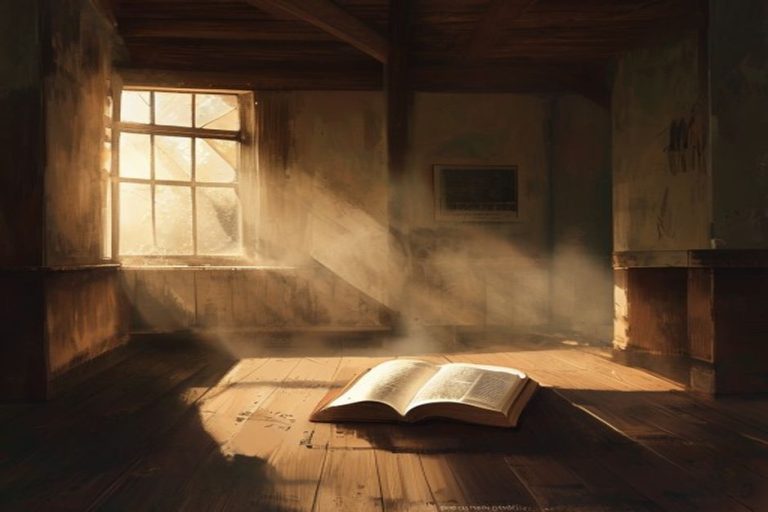
Open Bible in warm morning light inside a quiet room

Why Prayer Feels Dry Even When Faith Remains

Many Christians expect prayer to become difficult when life becomes openly sinful, distracted, or rebellious. What unsettles them more is another experience altogether: prayer remains regular, faith remains sincere, yet the heart feels little warmth in the act itself. Words are said. Psalms are read. Silence is kept. But the inward sense of nearness seems thin. It is possible to remain present before God and still feel, in a painful way, that prayer has become dry.

This dryness often troubles believers because it appears to call the whole spiritual life into question. If prayer is difficult, perhaps faith has weakened. If there is no sweetness, perhaps God is displeased. If the soul feels empty, perhaps one has somehow failed. Yet Scripture is much more patient than our suspicions. It does not speak as though every faithful prayer is emotionally vivid. It speaks of thirst, waiting, groaning, persevering, and hoping in the dark.

That matters because prayer is not sustained by consolation alone. It is sustained by truth, covenant, and desire for God, even when that desire feels wounded. The believer who continues to pray through dryness is not necessarily backsliding. He may, in fact, be learning a deeper form of fidelity than the one he knew when prayer came easily.

Dryness Is Not the Same Thing as Unbelief

Psalm 42 gives language for this distinction. The psalmist thirsts for God while also asking why his soul is cast down. Longing and sorrow coexist. The absence of relief is not proof that faith has vanished. It is often proof that faith is still alive enough to grieve the felt distance. A dead soul does not mourn the loss of communion. It hardly notices it. But a living soul feels the poverty of its own condition and cries out because God still matters.

This is one reason spiritual dryness should not be interpreted too quickly. Some seasons reveal negligence and need repentance. Others reveal the painful honesty of a heart that has stopped confusing religious activity with communion. The person who notices dryness may actually be awakening to the seriousness of prayer. He is no longer content with words that pass through the mouth untouched by the deeper life.

VineyardMaker has already reflected in the Beatitudes that poverty of spirit is not a decorative virtue. It is the beginning of truth before God. Dry prayer can become one of the places where that poverty is admitted. We arrive without pretense. We cannot manufacture devotion on demand. We can only bring our need and remain there.

God Sometimes Withdraws Consolation Without Withdrawing Mercy

Believers often assume that if God is kind, He will keep prayer emotionally reassuring. But the history of Christian spirituality has never taught that. Augustine, Bernard, and the desert tradition all knew that God may deny felt sweetness for a time without ceasing to give grace. Consolation is a gift, but it is not the foundation of the spiritual life. God Himself is the foundation. When consolations recede, the soul is confronted with a harder question: do I want the gifts of prayer, or do I want God?

That question should not be asked harshly. A tired Christian does not need accusation. He needs clarity. There are seasons in which the Lord trains His people by removing the supports they have leaned on too heavily. Not because He delights in deprivation, but because He wants love to become steadier than sensation. In Proverbs 3: trusting God in every step, the issue is not merely decision-making. It is the deeper refusal to lean upon our own understanding, including our understanding of what prayer should feel like.

To say this carefully: a dry season is not automatically advanced spirituality. It may expose sin, exhaustion, grief, or distraction. But neither is it automatically abandonment. The God of Psalm 63 is sought in a dry and weary land. The land is dry, and the prayer rises from within that dryness. The condition itself does not prevent communion. It becomes part of the prayer.

Prayer Is More Than What You Can Feel in the Moment

One of the most merciful texts for dry seasons is Romans 8, where Paul says that we do not know how to pray as we ought, and the Spirit helps us in our weakness. That is not only for moments of crisis. It is also for long periods when prayer feels partial, distracted, halting, and poor. The Spirit’s work is not suspended because our experience is unimpressive. Divine help does not wait for spiritual fluency.

This should correct a modern habit of measuring prayer almost entirely by immediate interior response. If the moment feels alive, we count it as prayer. If it feels blank, we suspect failure. Scripture gives a humbler account. Prayer includes petition, silence, waiting, lament, repentance, and even wordless longing. It is not invalidated by weakness. In many cases, weakness is where true prayer begins, because then we stop performing and begin asking for mercy.

That is why the slow wisdom reflected in House of Wisdom and Wisdom at the Crossroad matters here. God often forms people through ordinary persistence rather than dramatic breakthroughs. A person can kneel with little sense of achievement and yet be more truthful before God than when prayer felt full of self-satisfaction. Dryness can strip prayer down to its bare intention: I have come because You are God, and I need You even when I cannot feel You rightly.

How to Remain in Prayer When It Feels Empty

Christ’s teaching in Matthew 6 is simple and unspectacular: go into your room, shut the door, and pray to your Father who sees in secret. The command does not depend on emotional reward. The hiddenness is part of the discipline. Dryness is often made worse when we keep demanding a result from prayer that prayer was never designed to guarantee on command. The aim is not to produce an experience. It is to turn toward God with reverence and perseverance.

So remain with simple forms. Pray the Psalms when your own words feel thin. Keep a short rule rather than a heroic one. Confess sin plainly where needed. Give thanks even if gratitude feels small. Ask for desire when desire is weak. And resist the urge to abandon prayer until it becomes satisfying again. Luke 18 does not present perseverance as glamorous. It presents it as necessary.

It also helps to remember that dryness can be intensified by creaturely causes. Fatigue, anxiety, overwork, and private grief all affect the inner life. A believer is not made more spiritual by ignoring his limits. Sometimes fidelity means rest, honesty, or conversation with a wise pastor. The apostles themselves were not strangers to frailty, which is one reason the apostles remain useful companions. God forms real people, not disembodied ideals.

The Quiet Faithfulness of a Dry Season

The deepest danger in dry prayer is not that God has gone elsewhere. It is that we begin to think prayer is worthwhile only when it rewards us quickly. But love matures by remaining. A marriage cannot live on first delight alone. Neither can the life of prayer. There comes a point when the soul is invited to seek God because He is worthy, not because the hour felt luminous.

If prayer feels dry while faith remains, do not despise that season too quickly. Bring the dryness itself into God’s presence. Name it without exaggeration. Ask for mercy without demanding immediate relief. And continue. The Father who sees in secret is not absent from the room simply because the room feels silent. Often the most hidden prayers are the ones in which faith becomes cleanest, because there is less left to hold onto except God Himself.