How the Soul Is Lost in a Life That Still Looks Faithful

One of the more sobering truths in Christian life is that a person can remain outwardly respectable while becoming inwardly divided. The soul is not always lost in scandal. It is often lost more quietly than that, in a life that still looks faithful from the outside. Prayer may still be said. Duties may still be fulfilled. Scripture may still be quoted. Service may still be rendered. Yet beneath the surface, the center has shifted. God is no longer the place from which life is being lived. Something else has taken the throne: urgency, usefulness, recognition, control, or the need to appear spiritually sound.

This is precisely what makes the danger difficult to name. Obvious rebellion is easier to detect. Hidden displacement is more subtle. A person may continue doing many good things while no longer doing them from communion with God. He has not denied the faith. He has simply become unable to rest in the One he still claims to serve. In What good is it for us to gain the whole world but lose our souls?, VineyardMaker has already insisted that Christ’s warning is not hyperbole. But the warning must be carried into ordinary religious life as well. The soul can be spent not only on worldly ambition, but on a form of faithfulness that has become hollow at the center.

Faithful Appearances Can Conceal a Disordered Center

Scripture repeatedly refuses to let appearances settle the matter. It is possible to honor God with the lips while the heart remains far away. It is possible to perform religious action without spiritual truthfulness. That is why the deepest danger in the Christian life is not always immorality in its obvious form. Sometimes it is the gradual accommodation of the self to a life in which God is still acknowledged, but no longer truly trusted.

When that happens, obedience becomes strained. Prayer becomes largely functional. Silence becomes threatening. Rest feels irresponsible. A person continues to carry Christian responsibilities, but he carries them with an inward posture shaped more by anxiety than by faith. He remains active, perhaps even admired, but he is no longer inwardly gathered before God. The soul begins to thin out because it is being lived from too many false centers at once.

This is one reason contemporary believers often feel exhausted in ways that are not merely physical. Beneath fatigue there is often a more spiritual weariness: the weariness of maintaining a life that is no longer simple. The self is split between what it professes and what it actually fears losing. In that state, the soul is not nourished by pious activity. It is quietly consumed by it.

Usefulness Is a Poor Substitute for Communion

Among the most deceptive replacements for God is usefulness. Usefulness feels noble. It can even wear the appearance of charity. But usefulness becomes spiritually dangerous when it starts to function as a person’s measure. The question slowly changes from, am I abiding in Christ, to, am I still needed? From, is my life truthful before God, to, am I still producing something visible? Once that shift occurs, even service becomes vulnerable to corruption.

This is why some of the most responsible believers are also among the most spiritually at risk. They are dependable, generous, and capable. Others lean on them. They keep things moving. But they may do all this while neglecting the inward life from which faithful service must actually flow. Their labor remains real, yet their peace begins to disappear. They cannot stop, because stopping would expose how much of their identity has become fastened to function.

That is not far from what Christ warns against. To gain the world is not only to gain wealth or applause. It is also to gain the satisfaction of being indispensable while quietly forfeiting the life of the soul. The question is not whether usefulness has value. It does. The question is whether usefulness has become a counterfeit savior. In How to Keep Your Soul in a World That Rewards Everything Else, VineyardMaker argued that the soul is often lost through false measures. Usefulness can become one of those measures when it begins to decide our worth more than communion with God does.

Urgency Teaches the Soul to Live Without Presence

Another quiet destroyer of the soul is chronic urgency. A hurried life is not automatically an unfaithful life. But a life arranged by perpetual urgency becomes increasingly inhospitable to the presence of God. Urgency trains a person to move quickly past whatever does not produce immediate results. It narrows attention. It reduces prayer to efficiency. It makes contemplation seem indulgent and patience feel impractical. Over time, the soul begins to accept a world in which there is never enough room to remain before God without agenda.

This is one reason many sincere Christians find silence so difficult. Silence does not reward us quickly. It does not flatter our productivity. It reveals how restless we have become. In Why Prayer Feels Dry Even When Faith Remains, the discipline of staying before God even without felt consolation was treated as a necessary form of fidelity. That same truth applies here. A soul governed by urgency will often call this kind of remaining a waste. But the kingdom of God is not built only in what is measurable. The soul is preserved where a person consents to be present before God without demanding immediate payoff.

Urgency also distorts love. It makes other people feel like interruptions, not neighbors. It makes the tasks of faith feel like items to complete rather than a life to inhabit. It tempts us to confuse motion with obedience. But motion can hide emptiness just as easily as idleness can. A life can be full and still be inwardly absent.

Image Management Is Not the Same as Holiness

Some lose the soul less through usefulness than through image. They do not simply want to be faithful. They need to appear faithful in a particular way. They cultivate seriousness, correctness, competence, and even theological clarity, yet all the while remain guarded against the humiliations by which God usually purifies a person. They are willing to be seen as devout, but not eager to become poor in spirit.

The Beatitudes expose this false order. Christ blesses the meek, the merciful, the pure in heart, the poor in spirit. These are not poses. They are forms of inward surrender. In Day 8: Eight Maids A-Milking – The Beatitudes, VineyardMaker treated the blessed life as the shape of kingdom character rather than an ornament of religious identity. That point matters sharply here. Holiness is not the management of appearances. It is the slow undoing of self-importance under the mercy of God.

Image management resists that undoing. It wants to remain impressive. It wants to preserve moral coherence without passing through deeper repentance. And so a person may become increasingly practiced at looking stable while becoming increasingly unable to bear truth. The soul is endangered wherever image becomes dearer than honesty before God.

Wisdom Calls the Soul Back to Simplicity

If the soul is often lost through divided loves, then it is kept through a return to simplicity. Not simplistic thinking, but a simpler center. Wisdom reorders life around what is actually ultimate. It teaches the person to ask older and harder questions than modern life prefers: what am I loving, what am I fearing, what is shaping my pace, what am I unwilling to lose, and do my outward acts of faith still arise from actual trust in God? Such questions slow the soul down enough to expose its hidden loyalties.

This is why Proverbs remains a necessary companion to the inner life. Proverbs 8: A Practical Theology for Daily Life presents wisdom as something more demanding than cleverness. Wisdom stands at the crossroads because the soul is usually lost through accumulated choices, not only through great transgressions. A life becomes hollow by consenting too often to what is loud, urgent, flattering, and spiritually thin. It becomes whole again when it is brought back under the rule of what is weighty, patient, truthful, and eternal.

So how is the soul lost in a life that still looks faithful? Often by no longer noticing what has quietly become central. The person still does Christian things, but he no longer does them from peace, trust, or love. He lives by function, hurry, image, or fear. And because the outer form remains intact, the inner loss can continue for a long time without being confessed. Yet Christ’s warning is mercy for precisely this reason. He speaks before the loss is final. He calls the soul back while there is still time to return.

The answer, then, is not theatrical self-accusation. It is repentance that reaches the center. It is the willingness to become less impressive and more truthful. It is the recovery of prayer that is not merely strategic, service that is not identity, obedience that is not performance, and rest that is no longer treated as disloyalty to one’s calling. The soul is not kept by appearances. It is kept by remaining under God. And wherever that remaining is relearned, even a life that has become divided can begin, slowly and quietly, to become whole again.

How to Keep Your Soul in a World That Rewards Everything Else

Most people do not wake one morning and decide to lose their souls. The loss is usually quieter than that. It happens in small accommodations, in habits of noise, in the steady preference for what can be measured over what must be guarded. A person can remain outwardly respectable, productive, even admired, while becoming inwardly hollow. This is why Christ’s question remains so severe and so merciful at once: what does it profit a man to gain the whole world and forfeit his soul?

That question does not belong only to the visibly ambitious. It belongs to ordinary believers as well. We can lose the soul not only through public success but through private dispersion. We become too hurried to pray, too reactive to listen, too dependent on approval to tell the truth, too restless to endure hidden obedience. In What good is it for us to gain the whole world but lose our souls?, VineyardMaker has already reflected on the gravity of Christ’s warning. But the warning must be carried further. If the soul can be lost quietly, then it must also be kept quietly, through habits that seem small in the eyes of the world and decisive in the sight of God.

The Soul Is Formed by What It Repeatedly Loves

Scripture does not treat the soul as a vague religious ornament. It is the seat of desire, worship, memory, and orientation before God. A soul does not remain neutral. It is shaped by what it repeatedly attends to, what it fears, what it seeks, and what it consents to. This is why the Psalms speak so often in the language of thirst, refuge, and waiting. The soul becomes like the object it leans upon.

The modern world trains people to live almost entirely at the surface of themselves. Attention is fragmented. Worth is quantified. Urgency becomes a permanent climate. Under such conditions, even sincere Christians can begin to imagine that inward life is optional, as though prayer, examination, reverence, and silence were secondary to visible competence. But the soul cannot survive on efficiency. It survives by truth, by worship, by repentance, and by a steadier love than the market of public opinion can give.

This is why Romans 12 speaks not first of strategy but of transformation. The believer is told not to be conformed to this world, but to be renewed in mind. That renewal is not cosmetic. It is a reordering of perception itself. To keep the soul, then, is not merely to avoid scandal. It is to resist being inwardly catechized by a world that rewards speed, vanity, and self-display.

Worldliness Is Often More Ordinary Than We Admit

When Christians hear the word worldliness, they often imagine obvious moral collapse. Scripture is subtler. Worldliness can appear anywhere the soul begins to measure life by standards that exclude God. A person may remain doctrinally serious and still become worldly in spirit. He may value visibility over faithfulness, cleverness over wisdom, platform over prayer, and influence over holiness.

This is one reason the soul must be guarded in ordinary life. Not every corruption arrives through open rebellion. Much of it arrives through imitation. We begin to speak the language of outcomes and branding so fluently that we no longer notice what has been displaced. Even spiritual gifts can be misunderstood in this way. In Day 7: Seven Swans A-Swimming – The Gifts of the Spirit, the emphasis is on gifts as graces entrusted by God, not decorations for the self. The moment a gift becomes severed from love, humility, and obedience, it begins to deform the soul that carries it.

Worldliness, then, is not merely having too much. It is receiving one’s measure from the wrong kingdom. Christ’s warning about gaining the world is severe because the world offers compensation quickly. It pays in applause, distraction, stimulation, and the illusion of mastery. The soul, by contrast, is kept through slower means. It is kept where there is no spectacle: in truthfulness, in hidden prayer, in reverence, in mercy, in the refusal to become a divided self.

Wisdom Keeps the Soul from Being Spent on Trivial Things

One of the clearest gifts God gives for the keeping of the soul is wisdom. Not cleverness, not information, not spiritual novelty, but wisdom: the capacity to love what is truly worth loving and to order life accordingly. Proverbs does not offer wisdom as an intellectual achievement. It offers wisdom as a way of walking. That is why Proverbs 8: A Practical Theology for Daily Life remains so important for VineyardMaker’s direction. Wisdom stands at the crossroads because most people do not lose themselves in one final disaster. They lose themselves through many smaller choices made without holy seriousness.

To keep the soul, a believer must learn again to ask older questions than the culture permits. Is this good? Is this true? Does this deepen charity? Does this strengthen attention to God? Does this make me more patient, more whole, more able to remain in reality without fleeing into performance? Those are not glamorous questions, but they are wise ones. A soul is often preserved less by a dramatic breakthrough than by repeated refusals to squander itself on what does not endure.

Wisdom also teaches proportion. Not every opportunity deserves consent. Not every demand deserves urgency. Not every inner impulse deserves trust. The soul is kept when desire is instructed, not merely indulged. It is kept when life is arranged around what is weighty rather than what is loud.

The Soul Is Kept in Hidden Practices Before It Is Tested in Public

Christ’s teaching in the Beatitudes is essential here because it reveals what the guarded soul actually looks like. It is poor in spirit, meek, merciful, pure in heart, hungry for righteousness. In Day 8: Eight Maids A-Milking – The Beatitudes, the point is not sentimental virtue but the shape of a life that can bear the kingdom. The soul is not kept by self-protection alone. It is kept by becoming the kind of person who can receive God without resistance.

That formation happens mostly in secret. The prayer nobody sees. The repentance offered without drama. The decision to tell the truth when a lie would be easier. The choice to remain quiet long enough for vanity to lose some of its power. This is also why seasons of dryness should not be wasted. In Why Prayer Feels Dry Even When Faith Remains, the difficult grace of staying in prayer without immediate consolation was already named. Hidden fidelity in those seasons is not peripheral to the keeping of the soul. It is one of the ways the soul is actually strengthened.

Public crises reveal what private habits have formed. If the inner life is neglected for long enough, the soul becomes brittle. It may still perform well, but it cannot endure pressure without splintering. By contrast, hidden practices create interior substance. They make room for courage because they have already made room for God.

Keeping the Soul Requires Losing Certain Rewards

There is no way to keep the soul without disappointing some of the world’s expectations. A guarded soul will sometimes look unambitious, slow, or unimpressed. It will refuse opportunities that demand too much compromise. It will choose presence over constant availability, truth over image, and prayer over the frantic need to remain significant. In that sense, some worldly rewards really must be lost if the soul is to remain alive.

This is not an argument for withdrawal from responsibility. It is an argument for right order. We still work, build, teach, serve, decide, and endure. But we do so without handing the center of the self over to lesser masters. The soul belongs to God before it belongs to any task. Once that order is reversed, even good labor becomes corrosive.

So how is the soul kept? Not by panic, and not by spiritual theatrics. It is kept by turning again toward what is real: the word of God, the fear of the Lord, prayer that remains even when it feels plain, wisdom that refuses triviality, and obedience that accepts hiddenness. The world will continue to reward many things that cannot save. The Christian’s task is not to despise the world as creation, but to refuse its false measures. A soul is not preserved by gaining more. It is preserved by remaining under the rule of what is eternal.

And that means the question of Christ must remain near us, not as a threat shouted from afar, but as a form of mercy close at hand. What shall it profit us to gain what cannot last and lose what was meant for God? The soul is kept when that question is allowed to order our days before the losses become obvious.

Gain World Lose Souls

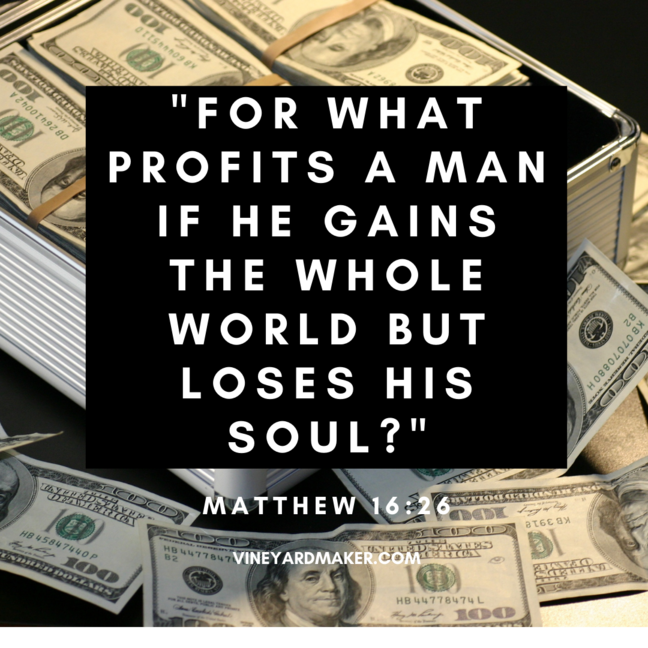
What good is it for us to gain the whole world but lose our souls?


“For what profits a man if he gains the whole world but loses his own soul?”Matthew 16:26, Mark 8:36, Luke 9:25


This is a simple yet profound question.

To gain the whole world is to receive all the world has to offer—money, fame, pleasure, power, prestige, etc.

To lose our soul means to trade/ forfeit our soul by giving it to Satan and doing evil/ harm to gain the riches that the world has to offer.

Continue reading